Heat Loss Calculations for Pipelines: Commonly Overlooked Factors and Their Impact on Heat Tracing Performance
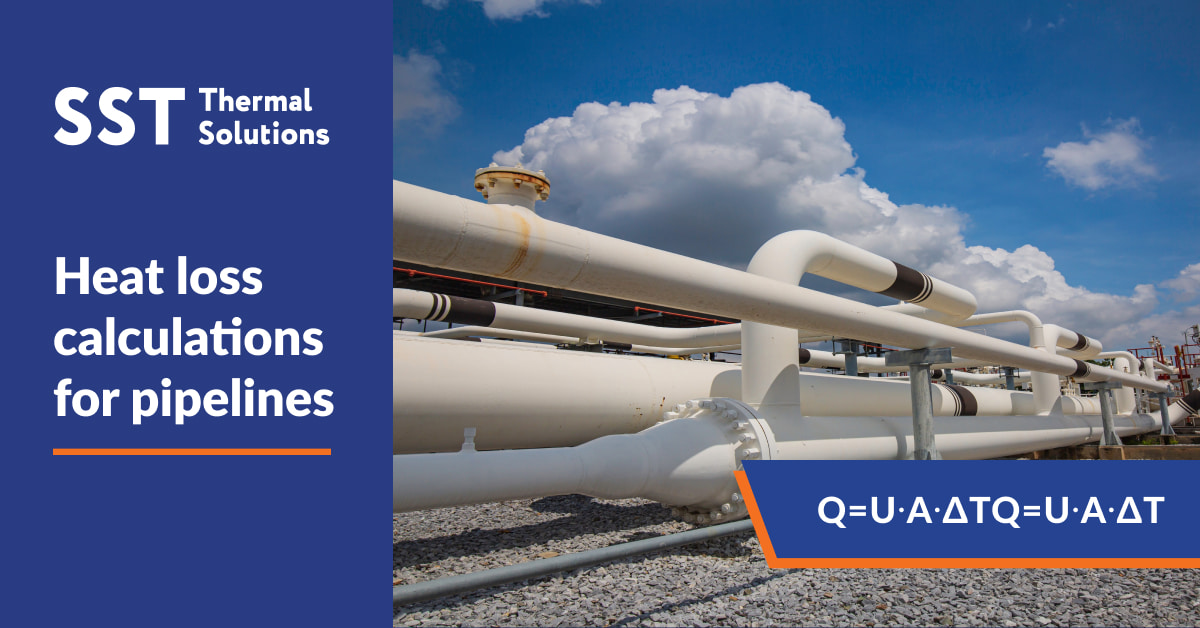
Standard heat loss calculations are typically performed using a formula that assumes steady-state conditions:
Q = U ⋅ A ⋅ ΔT
Engineers generally account for insulation thickness, minimum ambient temperature, and wind speed. On paper, the results often indicate acceptable performance.
However, field conditions frequently deviate from these predictions. Systems may experience temperature drift or fail to recover following a process shutdown. The issue is not necessarily the accuracy of the calculations, but rather the completeness of the thermal model.
The following three factors are commonly omitted from steady-state analyses, along with practical methods to address them.
1. Pipe Supports and Shoes as Thermal Bridges
Pipe supports, shoes, and hangers that penetrate or bypass insulation create direct conduction paths for heat loss. An uninsulated support can increase local heat loss by 300–500% relative to a fully insulated pipe section. Even where thermal breaks are installed, metal-to-metal contact provides a high-conductivity pathway that heat tracing must compensate for.
Recommended approach:
Add 1.5 to 2 times the normal heat loss per linear meter of support contact. Where feasible, employ pre-insulated supports or engineered thermal spacers. Ensure that heat tracing elements extend beneath or around the support zone, rather than terminating at its edge.
2. Transient Cooldown and Recovery Power Requirements
Steady-state calculations assume continuous, uninterrupted operation. Actual plant conditions often include power outages, steam supply interruptions, maintenance shutdowns, and cold starts. When a frozen line must be brought back to operating temperature, the required power is typically 3 to 5 times higher than the maintenance heat loss. Sizing a system solely for steady-state conditions will result in inadequate recovery performance.
Recommended approach:
Design for warm-up conditions. Specify a maximum allowable recovery time (for example, raising the line from -20°C to +10°C within 2 hours) and calculate transient power demand accordingly. Use this value, rather than the maintenance heat loss, as the design basis.
3. Fluid Properties Adjacent to the Pipe Wall: High Viscosity Effects
High-viscosity fluids, including crude oil, heavy oil, polymer melts, and certain chemical products, exhibit poor film coefficients at the inner pipe wall. Heat tracing elevates the pipe wall temperature, but the fluid layer adjacent to the wall moves slowly, and thermal conduction into the bulk fluid is limited. The result is a hot pipe wall with cold fluid at the outlet.
Standard calculations often assume perfect mixing or an infinite film coefficient. If the inside film coefficient (h_inside) drops below 30 W/m²·K, heat transfer becomes severely compromised.
Recommended approach:
Do not assume good mixing. Apply thermal conductive compounds between the heat tracer and the pipe wall, increase tracer density, or install multiple parallel tracing runs. For extremely viscous fluids, consider internal heat transfer enhancement methods or circulation heating.
Conclusion and Safety Margin
Accurate calculations combined with an incomplete physical model lead to undersized heat tracing systems.
Engineers are advised to add a 25–40% degradation margin to the final heat loss value to account for:
- Wet or aged insulation
- Compression of insulation at support points
- Internal or external pipe fouling
- Field installation variances
Recalculate using this margin, and subsequently validate the design through testing.
Sigmian engineers heat tracing systems based on actual operating conditions. Learn more.