Evaluating Tank Heating System Suitability for Real‑World Conditions: Key Questions to Address
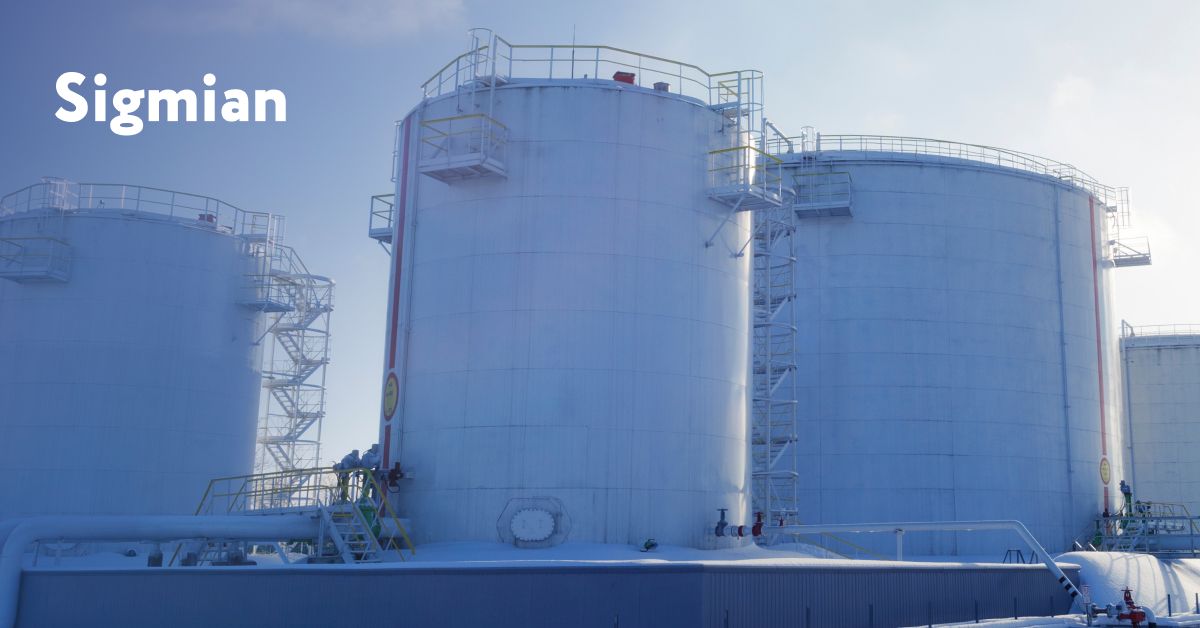
Tank heating is often treated as a secondary subsystem — until it begins to limit overall process throughput. From an engineering perspective, the root cause is rarely insufficient heating power. More frequently, it is a misalignment between how the system was designed and how it actually operates in the field.
Typical Scenario
A storage tank contains a temperature‑sensitive medium — for example, a high‑viscosity fluid such as heavy oil, polymer melt, or chemical intermediate with a strong temperature‑dependent viscosity profile.

What designers often assume:
- The tank maintains a stable, uniform temperature
- Viscosity stays predictable and constant
What actually happens in operation:
- Temperature gradients develop across the tank — sometimes 15–30°C difference between top, shell, and bottom
- Local cooling zones appear near supports, nozzles, hatches and bottom areas (these are thermal bridges)
- Viscosity increases unevenly — for many fluids, a small temperature drop can double or triple viscosity
- Flow behaviour in the outlet piping becomes unstable, shifting between smooth (laminar) and chaotic (turbulent) regimes

The result:
- Slower outflow — higher pressure drop means longer pumping time
- Longer transfer cycles — waiting for the tank to drain
- Pumps work harder and may run off their efficiency curve
- Tank doesn't empty completely — residual product remains in cold zones
- In worst cases: process delays or unplanned shutdowns

When a shutdown occurs (maintenance, power outage) or ambient temperature suddenly drops, the heating system cannot bring the tank back to temperature fast enough. The required recovery power is often 3–5 times higher than the steady‑state heat loss — but the system was never sized for that.
At this point, the heating system becomes a process bottleneck — not because it broke, but because it was not engineered for real‑world conditions.
Rethinking Tank Heating Design
To avoid this, tank heating design must go beyond simple nominal calculations. The following engineering questions help evaluate whether a system will hold up under actual operating conditions.
Thermal Design — Heat Loss Reality Check
- Are worst‑case ambient conditions (minimum temperature plus wind plus low solar gain) actually used — not just a textbook number?
- Are insulation properties realistic — meaning aged, possibly wet, or compressed at supports — rather than brand new and perfectly installed?
- Is heating power matched to actual heat loss zones? The roof loses heat fastest, the bottom couples thermally with the ground, and the shell is in between.
- Are critical spots — nozzles, manways, support saddles, instrument wells — covered with insulation and dedicated tracing, rather than just averaged into the total?
- Does the layout follow real tank geometry — conical bottoms, internal coils, agitator shafts — rather than an idealized cylinder?

Transient Performance — Cooldown and Recovery
- Can the system recover after an interruption — power outage, steam failure, or maintenance cooldown?
- What is the calculated heat‑up time from a cold start (tank has a minimum ambient temperature) to operating temperature?
- Are startup (empty cold tank) and restart (product inside, below setpoint) explicitly defined as design cases?
Medium Behaviour — Fluid Physics
- Is thermal stratification expected? A quick check using dimensionless numbers (Grashof and Prandtl) can tell whether natural convection will mix the tank or leave it layered.
- Will natural convection be enough to equalize temperature — or will hot and cold zones persist?
- How does viscosity actually change with temperature? Is the design based on real viscosity‑vs‑temperature data (e.g., from ASTM D341) — or on estimates?
Practical Constraints — Installation Reality
- Does the layout account for structural obstacles — stiffening rings, support brackets, internal ladders?
- Are thermal bridges identified? Every uninsulated metal support or nozzle creates a direct, low‑resistance path for heat to escape.
- Can the design be installed as intended? For example, can heating cable actually be wrapped around a bottom outlet flange or can a junction box be fixed in the specified location?
Control Strategy — Where and How to Measure
- Is temperature measured at representative points — top, middle, bottom — or only at one local spot right next to the heater?
- Is the control strategy matched to process sensitivity — simple on/off thermostat, PID loop, or something more predictive?
What a Well‑Engineered System Should Do
A well‑engineered tank heating system is not defined solely by its ability to reach and hold set temperature under ideal conditions.
It must:
- Maintain process stability — keep temperature and viscosity uniform across the tank
- Behave predictably — handle ambient temperature swings, partial filling, and intermittent draw‑off without surprises
- Recover after disturbances — bring the tank back from cold soak or shutdown within an acceptable time window
Engineering Perspective
At Sigmian, we approach tank heating as an integrated thermal engineering problem — not just heat loss calculations, but transient response, thermal bridges, fluid viscosity behaviour, and real‑world field conditions. Learn more.